
Nikos Deja Vu - Nuova Compagnia di Canto Popolare - Tammurriata Nera


Nikos Deja Vu Presents:
THE SCHOOL OF ARISTOTLE
ΤΟ ΣΧΟΛΕΙΟ ΤΟΥ ΑΡΙΣΤΟΤΕΛΗ
ΓΙΑ ΤΗΝ ΕΛΛΗΝΙΚΗ ΕΚΔΟΣΗ ΠΡΟΧΩΡΗΣΤΕ ΠΡΟΣ ΤΑ ΚΑΤΩ
Sacred place with worlwide value
A place of universal interest, the ruins of Aristotle's School, is a found only 2 kilometers away from the contemporary Naoussa, at the district of Isvoria Here is the place with the racing water and the deeply-shaded caves, mentioned by the ancient writers, where the greatest philosopher of the antiquity taught the greatness of classical Greek thought and the ideals of the Platonic philosophy to the King's of Macedonia, Phillip II, son, Alexander and the other nobles of the Macedonian court. The encounter of these two Great personalities of the ancient world at the Nympheon of Mieza would definitely affect the future of mankind, and of all Western Civilization.
The area of the Nympheon, that is the sanctuary dedicated to the Nymphs, is a very impressive natural landscape, where the ancient remnants - a wall prop of a two-floored arcade with Ionic columns forming a Π- combined with the three natural caves which are found there, constitute the main grounds of the School. The vertical surface of the rock, where the openings for supporting the roof's girders are discernable, comprised the back-end of the shady stoa, (built at 350 B.C. and later), where Aristotle taught «the doctrines of morals and politics" (Plutarch VII, 668) to the youths of the Macedonian Nobility. The landscape, where the Great Teacher rambled with his students on the fully vegetation riverbank trails, among calm and cool streams of water, gushed from the springs around, is completed by an even greater cave, a little further off, with two carved entrances, obviously for devotional use.
CULTURAL CENTER
A modern center of culture and recreation
The Cultural Center of Aristotle's School is a complete center of culture and recreation. It is situated at the district of "Isvoria", 2 Kilometers away from the center of Naoussa, and at the area surrounding the archaeological monument of Aristotle's School, the "Nympheon of Mieza". It belongs to the Municipality of Naoussa and it was donated by the great donator of the City, Christos Lanaras.
The modern architecture of the building, in which the wood, the metal and the stone predominate, harmonizes well with the environment of the place around.
Facilities provided at the Cultural Center
1. Exhibition room
2. Conference and video room
3. Reception hall
4. Restaurant and Refreshment room
5. Parking lot for cars and buses
At the convenient rooms of the Cultural Center, the visitor, after having a guided tour at the archaeological site of Aristotle's School, can get information about the history and the importance of the monument, and find relevant books, brochures, CD-Rom, DVD, gifts, souvenirs e.t.c.
The Conference room (80 seats) is of high specification. It is fully provided with modern audio-visual systems (projection, sound truck and translation center), being thus an ideal place for conferences, educational programs and festivities. At the same place the visitor can watch films and/or videos about the Great Philosopher Aristotle, the Archaeological sites (Aristotle's School, Macedonian Tombs of Anthemia, Ancient theater of Mieza) and the history of the heroic City of Naoussa.
INFORMATION
School's program
The Cultural Center of Aristotle's School is open daily
Monday to Friday from 09.00 -14.00
Weekends from 09.00 - 20.00
For the best furtherance of your congress or festivity organization, educational visit, or group visit, please, contact the head Office of the Cultural Center http://www.sxoliaristotelous.gr/en/contact.htm
ΕΛΛΗΝΙΚΗ ΕΚΔΟΣΗ
Η σχολή του Αριστοτέλους στα Ισβόρια Νάουσας
Τόπος με παγκόσμιο ενδιαφέρον είναι τα απομεινάρια της Σχολής του Αριστοτέλη, λίγο πιο κάτω από την σημερινή Νάουσα, στη θέση Ισβόρια. Είναι το μέρος με τα τρεχούμενα νερά και τα βαθύσκιωτα σπήλαια που αναφέρουν οι αρχαίοι συγγραφείς, όπου ο μέγιστος φιλόσοφος της αρχαιότητας δίδαξε το μεγαλείο της κλασσικής Ελληνικής σκέψης και τα ιδανικά της Πλατωνικής φιλοσοφίας στον γιο του Βασιλέα της Μακεδονίας Φιλίππου Β', τον Αλέξανδρο και τους άλλους ευπατρίδες της Μακεδονικής Αυλής. Η συνάντηση αυτών των δύο μέγιστων προσωπικοτήτων του αρχαίου κόσμου στο Νυμφαίο της Μίεζας έμελλε να επηρεάσει καθοριστικά το μέλλον της ανθρωπότητας, και ολόκληρου του Δυτικού Πολιτισμού.
Ο χώρος που καταλαμβάνει το Νυμφαίο, δηλαδή το ιερό το αφιερωμένο στις Νύμφες, είναι ένα πολύ εντυπωσιακό φυσικό τοπίο, όπου τα αρχαία λείψανα - ο τοιχοβάτης μιας διώροφης στοάς με ιωνικούς κίονες σε σχήμα Π - συνδυαζόμενα με τρεις φυσικές σπηλιές που υπάρχουν εκεί, αποτελούν τον κύριο χώρο της σχολής. Η κάθετη επιφάνεια του βράχου, όπου φαίνονται οι οπές για τη στήριξη των δοκαριών της στέγης, αποτελούσε το πίσω μέρος της σκιερής στοάς, που χτίστηκε τότε (350 π.Χ. και μετά), όπου δίδασκε ο Αριστοτέλης «τον ηθικόν και πολιτικόν λόγον (Πλούταρχος VII, 668) στους νεαρούς βλαστούς των Μακεδόνων ευγενών. Στο Αρχαιολογικό Μουσείο της Βέροιας υπάρχουν κεραμίδες και πήλινες σίμες από τη στέγη της στοάς. Το τοπίο όπου ο Δάσκαλος περιδιάβαζε με τους μαθητές του στα παρόχθια, γεμάτα από πυκνή βλάστηση μονοπάτια, ενώ γύρω τους ανάβλυζαν από τις πηγές και κυλούσαν ήρεμα δροσερά ρυάκια, συμπληρώνεται λίγο πιο πέρα με ένα ακόμη μεγαλύτερο σπήλαιο, με δύο λαξευμένες εισόδους, και σαφή λατρευτική χρήση.
ΤΟ ΠΟΛΙΤΙΣΤΙΚΟ ΚΕΝΤΡΟ
Σύγχρονο Κέντρο πολιτισμού και αναψυχής
Το Πολιτιστικό Κέντρο Σχολής Αριστοτέλους είναι ένα ολοκληρωμένο κέντρο Πολιτισμού και αναψυχής. Βρίσκεται στην περιοχή «Ισβόρια» 2 χλμ. από το Κέντρο της Νάουσας, και στον χώρο που περιβάλλει το αρχαιολογικό μνημείο της Σχολής Αριστοτέλους, το «Νυμφαίο της Μίεζας». Ανήκει στο Δήμο Νάουσας και είναι δωρεά της οικογένειας του μεγάλου ευεργέτη της πόλης, Χρήστου Λαναρά.
Η μοντέρνα αρχιτεκτονική μορφή του κτιρίου όπου κυριαρχούν το ξύλο, το μέταλλο και η πέτρα, εναρμονίζονται με το φυσικό περιβάλλον της περιοχής.
Στις εγκαταστάσεις του Πολιτιστικού Κέντρου λειτουργούν:
1. εκθεσιακός χώρος
2 αίθουσα συνεδρίων και προβολής.
3. χώρος υποδοχής-εξυπηρέτησης επισκεπτών
4. αναψυκτήριο-εστιατόριο
5. χώρος στάθμευσης αυτοκινήτων και λεωφορείων
Στους άνετους χώρους του Πολιτιστικού Κέντρου, ο επισκέπτης μπορεί, αφού ξεναγηθεί στον αρχαιολογικό χώρο της Σχολής Αριστοτέλους, να ενημερωθεί για την ιστορία και τη σημασία του μνημείου και να αποκτήσει βιβλία, έντυπα, cd-rom, dvd αναμνηστικά είδη δώρων κλπ.
Η αίθουσα συνεδρίων (80 θέσεων) είναι υψηλών προδιαγραφών. Διαθέτει σύγχρονα οπτικοακουστικά συστήματα (προβολής, ήχου και μεταφραστικό κέντρο). Έτσι είναι ιδανικός χώρος για τη φιλοξενία συνεδρίων, εκπαιδευτικών προγραμμάτων και εκδηλώσεων. Επίσης, στην αίθουσα γίνονται προβολές ταινιών και video με θέμα το έργο του φιλόσοφου Αριστοτέλη, τους αρχαιολογικούς χώρους (Σχολή Αριστοτέλους, Μακεδονικοί Τάφοι Ανθεμίων, Αρχαίο θέατρο Μίεζας) και για την ιστορία της Ηρωικής πόλης Νάουσας.
ΠΛΗΡΟΦΟΡΙΕΣ ΛΕΙΤΟΥΡΓΙΑΣ
Το Πρόγραμμα Λειτουργίας της Σχολής
Το Πολιτιστικό Κέντρο Σχολής Αριστοτέλους λειτουργεί ως εξής:
Δευτέρα-Παρασκευή: 09:00-14:00
Σάββατο-Κυριακή: 09:00-20:00
Με σκοπό την καλύτερη εξυπηρέτηση του κοινού η διοργάνωση εκδηλώσεων, εκπαιδευτικών προγραμμάτων, η φιλοξενία συνεδρίων, καθώς και η επίσκεψη οργανωμένων εκδρομέων (group) γίνεται μετά από επικοινωνία με τη Διεύθυνση του Πολιτιστικού Κέντρου.
ΣΤΟΙΧΕΙΑ ΕΠΙΚΟΙΝΩΝΙΑΣ
ΔΗΜΟΣ ΗΡΩΙΚΗΣ ΠΟΛΗΣ ΝΑΟΥΣΑΣ
ΠΟΛΙΤΙΣΤΙΚΟ ΚΕΝΤΡΟ ΣΧΟΛΗΣ ΑΡΙΣΤΟΤΕΛΟΥΣ
Περιοχή Ισβόρια Νάουσας
ΤΚ 59200 Νάουσα
Τηλ. 23320 43437
FAX 23320 43438
info@sxoliaristotelous.gr
www.sxoliaristotelous.gr
Nikos Deja Vu
http://n1999k.blogspot.com
http://n1k0s.multiply.com
Patmos Island - Greece
The Island of the Apocalypse
The island of Patmos is an incredible destination. With a rich history and picturesque beauty, Patmos is one of the northernmost islands of the Dodecanese complex in the Aegean Sea.
It has a population of 4-5000 and an area of only 35 kilometers. The island has been inhabited since 3,000 BC, and excavations of fortresses, cemeteries, pottery fragments, sepulchral stones, and other artifacts significant to the Greek Orthodox tradition are evidence of a densely populated area with thousands of years of dynamic cultural and political activity.
In 2006, the island's historic center of Chora, the Monastery of Saint Ioannis (John) the Theologian, and the Cave of the Apocalypse were declared World Heritage Sites by UNESCO. Patmos is also home to the Patmian School, a notable Greek seminary.
The walls of the ancient Acropolis, which is situated over the hill Castelli, were built in the 6th and 4th centuries BC on Patmos. It is recorded that near the Acropolis stood the Apollo Temple, the Bacchus Temple, and the Hippodrome. In ancient times, the goddess Artemis was particularly adored in Patmos. She was considered to be the patroness of the island, and according to Greek mythology, the island owes its existence to her.
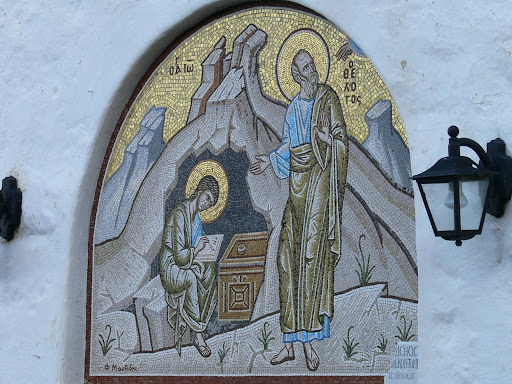
In 95 AD, Patmos welcomed Saint Ioannis (John) the Apostle to its shores. Saint Ioannis (John), who was exiled to the island, wrote the Book of Revelation also known as "The Apocalypse" while on the island. The Book of Revelation The Apocalypse of Ioannis (John) is the last and only prophetical book of the New Testament. In its prologue, Saint Ioannis (John) wrote:
"I dwelled in an island of which name is Patmos, as to preach the word of God and have faith in the martyrdom suffered by Jesus Christ"
The Cave where Saint Ioannis (John) received his Revelation, the Cave of the Apocalypse, attracts thousands of religious pilgrims and other visitors every year. The Cave of the Apocalypse is one of the few places in the world where religious ceremonies that date back to early Christian times have been practiced uninterrupted throughout the centuries.
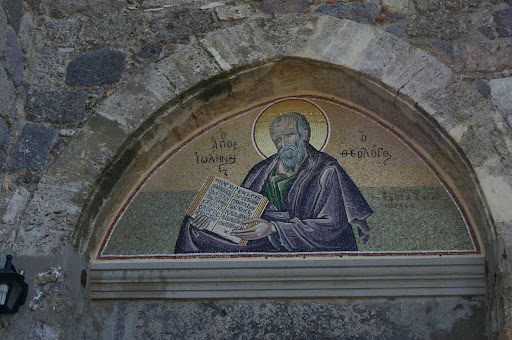
The Cave of the Apocalypse and the Monastery of Agios Ioannis Theologos -- Saint Ioannis (John) the Theologian, founded by Saint Christodoulos -- are located in Chora, the capital city of the island, and together they constitute a wonderful traditional Greek Orthodox pilgrimage center with outstanding architectural features.
The Monastery showcases the best of wood carving and other carpentry arts. Inside, there are eight small chapels with rare authentic icons of Byzantine art, including the icon of St. John the Theologian donated by the Emperor Alexios I and the mosaic icon of St. Nicholas, and the walls are decorated with exceptional frescoes from various periods. The church’s altar has an imposing stone that originally was part of the temple of the goddess Artemis, and in the front yard of the Monastery there are several ancient pillars.
The Monastery also contains a rare mitre of the Emperor of Byzantium Alexios I, the mitre of Neophytos VI, and a medal cross of Patriarch Gregory V. Other precious relics that have been preserved for many centuries include sacerdotal garments of bishops woven in gold thread with exceptional embroideries surmounted by precious stones and large glass cases with impressive displays of sacred objects, including ornate crosses, sacred communion cups, and other mitres of emperors and patriarchs.
Another place of particular interest is the Library of the Monastery, which houses a truly impressive selection of ancient documents: more than 2,000 volumes of ancient editions and 13,000 rare copies of various documents, including approximately 900 manuscripts, about 325 of which are written on parchment.
Some of the most important manuscripts in the Library are the manuscript of Diodore Sikeliotis, the Purple Code, an incomplete copy of Evangelist Mark Gospel, the book of Job, manuscripts of the 7th and 8th century AD, sermons of St. Gregory the Theologian, and the Gospel of Four (dating from 1345 AD and containing rare images of the Evangelists).
In addition, there are 29 roll manuscripts on parchment containing the texts of masses written by St. Basil the Great and St. John the Chrysostome, as well as a variety of documents about Byzantine emperors, patriarchs, princes, and other dignitaries.
As you can imagine, an intense religious aura is apparent across the small island of Patmos, since it is home to more than 50 churches and monasteries!
However, visitors have the chance to visit not only significant Greek Orthodox religious places, but many ancient settlements and religious sites as well.
One such settlement is Agrikia, which is situated where the temple of Zeus once was located, along with ruins from ancient buildings and walls dating to the time of Byzantine Empire.
Undoubtedly, Patmos is memorable for its spiritual and historical sites. But sandy beaches, whitewashed stone buildings, warm hospitality, and delicious homemade food of the islanders complement the historical experience and more than satisfy any discerning visitor.
There is a lot more to be discovered. If you enjoy the outdoors, you'll love to explore the island's unique terrain, which features many tall mountains as well as some impressive caves.
The highest peak is Profitis Elias, which is 270 meters above sea level. (The monastery of the Apostle Ioannis (John) is nearly as high at 240 meters above sea level.)
The caves of Patmos are sensational: the most important is the Cave of the Apocalypse, which is 6.60 meters in length and 5.50 meters in width, followed by the cave of Kinopa, which houses a small chapel, and the caves of Apollo, Arapi, Sikamia, Aliki, and Fournakia Foko.
There are many gulfs in the island, creating exquisite beaches and magical scenery, ideal for swimming in the crystal clear deep waters. All around the island and within its gulfs there are small islands that add to the attractions of the island of Patmos. The largest of these is Hiliomodi, which is situated in the gulf of Skala. On this small island, the church of Saint Panteleimonas is located and is celebrated on the 27th of June every year. Further north are located the small islands of Santa Thekla, Saint George, Kentronisi, Tragonisi, Prasonisi, and Petra.
The island offers a wide range of water sports and there are many choices available at most organized beaches and hotel resorts. Fishing lovers, as I am, will surely be satisfied, since the island provides excellent areas for fishing, both in its gulfs and off of the small surrounding islands. Furthermore, the calm sea and the sparkling waters are perfect for scuba diving.
My stay on the island of Patmos was both relaxing and enjoyable either at the hotel resorts or fully furnished rental rooms that are available all over the island. You may rent a car or use local transportation easily to access ancient and holy sites, spectacular beaches, and an abundance of restaurants, pretty cafes, boutiques, and nightclubs.
I truly enjoy observing the Cycladic architecture of the Greek Isles, walking in flagstone alleys with doors, roofs, and shutters painted in vibrant colors.
Well-tended flowered courtyards filled with Mediterranean aromas, numerous chapels scattered around, the warm hospitality of locals, the mouthwatering food, and precious ancient and religious sites set against the deep blue backdrop of the Aegean Sea make Patmos, the island of Apocalypse, a true treasure...


The Greeks in Romania
Historical Document
There has been a Greek presence in Romania for at least 27 centuries. At times, as during the Phanariote era, this presence has amounted to hegemony; at other times (including the present), the Greeks have simply been one among the area's other ethnic minorities.
Ancient and Medieval Period
The Greek presence in what is now Romania dates back as far as the apoikiai (colonies) and emporia (trade stations) founded in and around Dobruja (see Colonies in antiquity and Pontic Greeks), beginning in the 7th century BC. Starting with the Milesian colony at Istros, the process reached its height after Tomis was founded in the 5th century BC. Although forever subject to the Dacian interference and easily disrupted by changes in the politics of neighbour tribal chieftains, the colonies prospered until being briefly submitted in various forms by King Burebista (late 1st century BC). Immediately after, and for the following centuries, they were stripped of their privileges by their new Roman masters, and followed the Empire into its crises.
The Byzantine Empire was a living presence north of the Danube, maintaining a cultural hegemony over the lands virtually until its disappearance (one doubled by certain periods of political dominance in such places as Tomis and Tyras).
Early modern Period
After the fall of the Empire, the Hospodars of Moldavia and Wallachia (the Danubian Principalities) often took on the patronage of many Greek-proper cultural institutions such as several monasteries on Mount Athos, gestures guaranteed to provide prestige in an Eastern Orthodox culture. To this was added the exodus of Byzantine officials and commoners to the two countries, which were at the time under a rather relaxed Ottoman tutelage. They took opportunities to advance in office, and from early on included themselves in the inner circle of power. This meant not only the reliance of Princes on a new elite (more often than not, also one to provide it with the funds needed by the administrative effort), but also the gradual ascendancy of Greeks to the thrones themselves.
The rapid change brought them much hostility from traditional boyars. Landowners in a rudimentary economy, accustomed to have an important say in political developments, these found themselves stripped of importance in the new structure, and became bitterly hostile to the immigrants. However, this was not the only notable trend: there were numerous cases of intermarriage at the top of the social scale (and not only), the arguably most famous of which being the ones inside the very powerful Cantacuzino family.
The Phanariote period
With the early 18th century emergence of Phanariote rule, Greek culture became a norm. On one hand, this meant a noted neglect for the institutions inside the countries; on the other, the channeling of Princes' energies into emancipation from Ottoman rule, through projects that aimed for the erasing of inner borders of the Empire, moving toward the creation of an all-Balkan, neo-Byzantine state (seen as the extended identity of Greekdom). To these was added the omnipresence and omnipotence of Greek ethnic clerics at all levels of the religious hierarchy, with many monasteries becoming directly submitted to similar institutions in Greece, after being gradually granted by successive Princes.
Thus, the emergence of Greek nationalism opened the two lands to revolution, as the main concentrations of political power available to it at the time, and the ones sharing a border with the expected supporter of the cause - Imperial Russia. The Wallachian stage of the Greek War of Independence consumed itself in a conflict between the initially supportive Anti-Ottoman Revolt led by Tudor Vladimirescu and the Philiki Etaireia, while Moldavia was under Greek occupation for a limited duration. The outcome only served to stir up animosity, and the Ottomans were receptive to the demands, putting an end to the Phanariote system in 1822.
19th and 20th centuries
In time, most Greeks lost their specificity and became fully integrated (for example, a sizable portion of noble families considered "Phanariote" contributed to the adopted culture more than local ones).
With new trends of migration, Romania became a less important target for exiled Greeks, and this became limited to people of lower social status—with ethnic Greeks being most visible as entrepreneurs, middlemen traders, and especially sailors (both on the Danube the Black Sea—in the case of the latter, after the integration of Dobruja in 1878, which also gave Romania a new population of Greeks, already on the spot).
The communities were largely prosperous and maintained specific cultural institutions; they attracted a new wave of arrivals when Greece was hit by the Civil War, in the late 1940s. This situation was challenged by Communist Romania, with the properties of most organizations and many individuals being confiscated, and hundreds of Greek ethnics being imprisoned on sites such as the Danube-Black Sea Canal.
Present situation
According to the Romanian census of 2002, the Greek community numbered 6,472 persons, most of whom live in Bucharest and its surrounding area. Next in line come the Dobruja counties of Tulcea and Constanta, and the Danube-facing ones of Braila and Galati. The 1992 census however found 19,594 Greeks; this shows the tendency of ethnic Greeks outside of Greece to acquire Greek citizenship and immigrate to Greece as homogeneis (ïìïãåíåßò - persons of Greek descent). According to the General Secretariat for Greeks Abroad (a dependency of the Greek Ministry of Foreign Affairs) the Greek community in Romania numbers 14,000.
The Hellenic Union of Romania, founded in 1990, represents the political and cultural preservation interests of the community, notably by providing its representatives in the Chamber of Deputies of Romania.
Greco-Romanian relations
Greco–Romanian relations are foreign relations between Greece and Romania. Diplomatic relations were established on February 20, 1880, at the legation level, and were raised to embassy level on January 1, 1939. There has been a Greek presence in Romania for at least 27 centuries. At times, as during the Phanariote era, this presence has amounted to hegemony; at other times (including the present), the Greeks have simply been one among the area's many ethnic minorities. Since the fall of communism and the return of democracy in Romania, many Romanians have emigrated to Greece for economic reasons. Both countries are full members of the European Union, the Council of Europe, the NATO and the Organization of the Black Sea Economic Cooperation (BSEC).
The level of Romanian-Greek bilateral relations is considered exceptionally good as Greece has warmly supported and contributed to Romania's entry into NATO and prompt accession into the European Union. Greece was the fifth member state of the EU and first among the old members to ratify the Treaty of Accession of Bulgaria and Romania to the EU. Greece is among the three top investors in Romania, with almost 800 active businesses and invested capital totalling 3 billion euros. About 6,500 ethnic Greeks live throughout Romania.
Hellenic – Romanian Defence Cooperation
The Defence cooperation between the Armed Forces of the Hellenic Republic and Romania has reached a high level and is defined by the bilateral Military Cooperation Agreement signed on 2002. The Agreement foresees the execution of several activities in the framework of an annual bilateral military cooperation program. The program indicatively includes the execution of joint military exercises, exchange of port visits, participation of staff officers in regular meetings and conferences, exchange of instructors and students in various military courses, exchange of vacationers e.t.c.
Greek Business in Romania (April 2010)
With over 4,000 Greek companies in Romania and a combined investment of EUR 3 billion, the Greek community in Romania has grown and strengthened over time, permanently looking for new opportunities and projects. Greek businesspeople are among the most long-standing foreign direct investors in Romania. Many of them started operations on the local market as long as 15 years ago, a period in which most of them adapted to the colorful local economic climate. The Romanian market has seen considerable expansion in the past years, making it a favorable one among Eastern European countries.
Romtelecom
Romtelecom is the largest telecommunications company in Romania; the majority of shares are held by the Greek telecommunications company OTE (54.01% of shares). The Romanian state also has a minority stake of 45.99% in the company. The company had a monopoly for the provision of fixed telephony services until January 1, 2003. Currently, according to the OTE Group 2006 1st Quarter Results Press Release, Romtelecom has 3,835,647 fixed telephony lines, down from 4,279,038 at the end of 1st quarter 2005. Romtelecom has also the second CDMA network in the country.
Greek banks in Romania (June 2010)
Hellenic banks in Romania report total profits of over EUR 32.5 M in Q1 of 2010, Hotnews reports. Banca Romaneasca had the biggest profit - EUR 12 M, followed by Piraeus Bank, with a net profit of EUR 10.3 M. Alpha Bank came in third with EUR 8.1 M profit, Economic Daily reported.
Twenty-two per cent of the local banking sector is covered by banks with Hellenic equity having major real estate exposures. However, recent difficulties in Greece do not seem to have had powerful direct effects in Romania because the Romanian banking industry, including Greek banks, is well-capitalised. Romanian banks' average capitalisation rate is now 14 per cent, a lot above the minimum requirement, and Hellenic banks are also soundly capitalised and closely watched by the Romanian central bank BNR.
Under the said conditions, Piraeus Bank Romania's gross profit posted for Q1 this year grew to EUR 10.3 M. The bank yesterday informed that managed assets on March 31, 2010 had been up by 2 per cent from year earlier, topping EUR 2 bln. In addition, in Q1, attracted deposits' volume rose by 7 per cent from year earlier. Piraeus Bank Romania's total deposits attracted had exceeded EUR 1.19 bln in March 2010.
Alpha Bank also posts a profit before tax of EUR 8.1 M, with bad loans up to 4.3 per cent. In a report to the Hellenic stock exchange, the Greek lender currently has 8.3 per cent market share in Romania compared to 8.9 per cent at the beginning of 2010. The bank has awarded total loans of over EUR 4 bln and raised deposits of over EUR 1.5 bln. The bank's profit was down by 62 per cent from year earlier in the context of bad loan losses amounting to EUR 24.5 M according to disclosures to Athens-based stock exchange.
Another Greek bank, Emporiki, in April 2010 injected EUR 25 M into its Romanian subsidiary after a previous equity injection of RON 78.5 M performed in February. Shareholders find that Emporiki Bank Romania has consolidated its position on the local market as its lending portfolio has gone up by 61 per cent and deposits by 21 per cent in the last two years.
Hellenic financial group National Bank of Greece (NBG) - majority shareholder in Banca Romaneasca - posts net profit of EUR 12 M for Q1. Earnings were higher by 71 per cent on a year over year basis, according to the groups' reporting in Athens. The same Hellenic group also operates a leasing company, a stock brokerage company and an insurance brokerage company, with reported results being consolidated for all subsidiaries. The hike in net profit came from the growing operating income especially the fee and commission income registering a four-fold increase at EUR 12 M.
Notable Romanian people of Greek origin
Phanariotes
the Callimachi family
the Caradja family
Nicolae Caradja
Jean Georges Caradja
the Mavrocordatos family
Nicholas Mavrogenes
Constantin and Alexandru Moruzi
Alexander and Constantine Ypsilanti
Constantine and Alexander Hangerli
Non-Phanariote rulers over the Danubian Principalities
Ioan Iacob Heraclid
Gheorghe and Constantin Duca
the Cantacuzino family
Modern-day persons of Greek origin or heritage
Cezar Bolliac - writer and political activist
Elie Carafoli - engineer, pioneer in aerodynamics
Ion Luca Caragiale - writer and playwright, his uncles Costache Caragiale and Iorgu Caragiale - actors, and his son Mateiu Caragiale - novelist and poet
Radu Beligan - Romanian actor
George Ciprian - actor and playwright
Jean Constantin - actor
Noti Constantinide - diplomat
Elena of Greece - Queen Mother and Regent of Romania
Elena Farago - writer
Panait Istrati - writer and political activist
Antigone Kefala - poet
Nicolae Malaxa - industrialist
Jean Moscopol - singer
Alexandru Paleologu - writer, diplomat, politician
Dimitrie Panaitescu Perpessicius - literary critic
Calin Popescu-Tariceanu - Prime Minister of Romania
Iannis Xenakis
Nikos Deja Vu
n1999k.blogspot.com


